I never seem to have the right emotional response to anything.
When will I get it right?
I hear you. Oh, how I hear you.
There is one thing you need to know and you might not believe even as you read here, on this very page. If there is one thing that you need to know in life, and it took me far too long to learn this, is that your feelings are (or should be) the guides for your life. Not only do you get to pay attention to them, you really need to pay attention to them. You not only get to make decisions based on how things make you feel, but you really need to make decisions based on how things make you feel.
For so long I truly believed that my feelings were meant to be conquered. I believed that being a perfect person meant having complete control over my feelings, being able to manipulate them, suppress them or highlight them at will. I have spent countless thousands of hours trying to suppress, change, rewire, obliterate my emotions. To great success in some cases. It turns out that I was wrong in doing this.
When I went to see the Princess Bride (in the late 1980’s), I cried with sadness, even though it was a comedy. There was a torture scene that I think was meant to be comedic, but it struck me as terribly sad. Everybody laughed at my reaction, and I laughed with them, tucking away the information in my brain that my emotional reactions were somehow broken.
Now my attempt to suppress and control my emotions resulted in me lightening up about myself, learning to laugh at myself.
Cairn: Learn to Laugh at Yourself
Learning to laugh at yourself is such a gift, as long as you don’t take it too far. Finding reasons to laugh and poke fun at yourself can ease the burden of living. It also helps you to give others the benefit of the doubt. A little self-deprecation is a very good thing, as evidenced by comedians that use this type of humor – it’s funny.
Learning to laugh at yourself is an antidote to defensiveness, which is draining for all involved. So learn to laugh at yourself when appropriate. It will improve your life.
And yet, while laughing at yourself can be restorative and healthy, it morphs from lighthearted teasing to bullying when you begin to tell yourself (in amongst the laughing) that you are wrong and that those that laugh at you are right. This is a very fine line between letting people laugh at you and letting them laugh with you. Trust me, from personal experience, don’t let it cross over that line. Don’t take it too far.
Back to the topic of emotions – I learned very early that my emotions would lead me astray.
I trained myself to reconsider my anger and see how when I thought I was angry with others, I was really just projecting onto them.
I trained myself to suppress (to the best of my ability) my sadness. I thought it exposed me as week. I tried to put on a happy face, not very successfully most of the time.
I trained myself to hide my nervousness. Never let them see you sweat. Fake it until you make it.
I conquered my fears – heading straight into them and obliterating them.
And the thing is that all of this was useful to some degree. But I was ignoring what these emotions (and others) were trying to communicate to me.
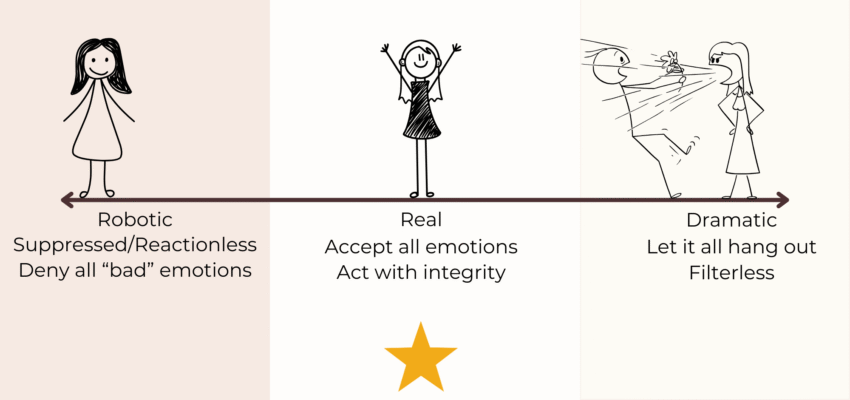
Now I am not, in any way, advocating for a life of just letting it all hang out. Babies just let things hang out, refreshingly so. But we aren’t babies, screaming when angry and sobbing when sad. Nor do we need to be robotic, smiling when angry and smiling when sad.
There is a middle ground – being real. This is where you accept and let yourself feel your emotions rather than fearing them or trying to suppress them. This is where you resist the urge to judge yourself for whatever you are feeling and equally resist the urge to let all of your emotions (and any associated unfiltered reactions) hang out.
I know that we’ve heard it before: There are no right emotions and no wrong emotions.
What makes you sad, makes you sad. What makes you angry, makes you angry. What makes you happy, makes you happy.
The truth is that the world will send us mixed messages about emotions. This well-meaning advice about emotions tends to stop where people start not understanding the emotions that they are seeing. In short, people become very uncomfortable when people aren’t reacting the way that they think they should be reacting. That is when they will start telling you that your emotions are wrong.
In my life, I know that my emotional reaction to The Princess Bride (sadness) was seen as the wrong reaction. My emotional reaction to dogs (fear) was seen as the wrong reaction. My emotional reaction to many of the events of my childhood (sadness) was seen as evidence that I was defective.
Even the things that bring us joy are sometimes criticized and used to prove that we should not trust our own emotions. That brings you joy? For example, I’m not one to love relaxing on the beach for hours on end. I simply don’t enjoy it. But I do enjoy riding my bike for hours on end instead. If you take me on a beach vacation, I’m more likely to be seen riding my bike away from the shore than sitting in the sand. Because this is different than many people, I’ve been asked, what is wrong with you?
It is important to learn to recognize what that joy feels like – train yourself to recognize it when it comes up. It’s equally important to learn to recognize what sadness or anger or fear or any other number of emotions feels like for you. How do you know when you’re sad? So many of us feel that discomfort and immediately turn to something meant to squelch it or distract us from it. Maybe you turn to food when you’re actually just sad. Do you find yourself eating candy rather than crying? Is it possible that you don’t want the candy – instead you want to cry? Then cry. Allow yourself to feel the feeling.
Maybe you think you’re sad when you are actually feeling anger? Maybe you think you’re angry when you are actually afraid? Emotions can get twisted in a variety of ways that are unique to each individual.
Resist the urge to dismiss this as overly-emotional crap.
While this all might sound like a very small thing, something inconsequential to your life, I assure you that it can be intensely lifechanging.
What might at first glance sound like self-indulgent crap actually has the power to give you the freedom that will give your life meaning.
As trivial as this might sound, learning to feel your emotions is the stuff that life is made of.
If this takes you the rest of your life to understand, then spend the rest of your life trying to understand it.
Don’t push it away.
You have every right to feel your feelings. You will naturally have an emotional response to anything that happens in your life – sometimes you won’t understand those responses; sometimes others won’t understand them. That doesn’t change the reality of the emotion you are experiencing.
Let’s take a look at an example:
Let’s say you are at a gathering of people and something isn’t sitting right with you, something you can’t put your finger on.
What might your response be?
A. You beat yourself up by telling yourself that something is wrong with you for not enjoying this when everybody around you is. So you fake a smile, stay for the gathering, leaving at the end with a stomach ache and feeling drained.
B. You pick a fight with the host, and then storm out angrily or pretend to go to the bathroom and leave when nobody is watching.
C. You recognize that something is off, so you start to pay attention to what might be going on with you. Rather than bolting immediately or staying indefinitely, you spend the next little while tuning into what you might be feelings. After a reasonable amount of time, you might thank the host and let them know that you need to be on your way.
I have too often found myself either pushing through in situations where I was uncomfortable or expressing my anger in ways that were unbecoming and likely result in my not being invited back in the future. Very rarely have I spent the time to become aware of the source of my feelings or even what the feelings were.
Sometimes you will find that you are just having an off day. Other times you will find that there is something more important to pay attention to. But your emotional responses, your feelings, can be trusted to guide you toward that knowing.
Sadness lets us know that we are losing something valuable to us.
Anger lets us know that a boundary has been crossed.
Fear lets us know that we are potentially in a situation that we need to change.
Joy lets us know that we love something.
This doesn’t mean that we need to do anything dramatic in response to experiencing these feelings. Think of them as a gentle guide that we can sit with for a while and respond to slowly.
Sadness is often seen as something to be avoided, but what if our response was to feel the sadness?
Anger is often seen used as fuel for violence or retaliation, but what if we experienced anger and made quiet changes in where we draw our boundaries?
Fear is often seen as a sign of weakness or something to be conquered, but what if we begin seeing our fear as information about how to keep ourselves safe?
Joy is often seen as indulgent, but what if we let this joy lead us down paths previously unknown to us?
So are your emotional responses wrong? No.
Spend the time to identify the real feeling, rather than labeling everything as anger or sadness or joy or another emotion. Spend the time to differentiate and really feel each emotion.
Do you find yourself watching the end of sad movies so that you have a reason to cry? Do you find yourself crying at odd times? Do you find yourself not crying when you want to? Are you a person that says that you “don’t cry”? Maybe you turn to food or alcohol? Or maybe you cover your sadness with an overlay of anger? If that’s you, then you could benefit from feeling your sadness.
Do you find yourself funneling your anger into your workouts? Do you find yourself becoming angry at relatively minor slights? Does anger feel like your only emotion sometimes? On the other hand, do you find yourself boasting to others about how easygoing you are, how nothing angers you? If this describes you, then you could benefit from cleanly feeling your anger.
Do you find yourself avoiding the things you love most because you’re embarrassed or you don’t think those things are cool? Do you find yourself being overly responsible, always putting work ahead of having fun? Do you find yourself drawn to the hardest things you can possibly do, rather than following your passions? Do you find yourself making things into tasks so that you don’t have to feel guilty doing them?
I suppress my crying in many situations (at the end of movies, with my kids, etc.). I feared that letting myself feel sad would lead me down a path of never feeling happy again.
I also boasted for years that I was imperturbable, unoffendable. I apologized to people who repeatedly wronged me, suppressing all of the anger under a layer of sadness. Yes, the anger still came out at odd times, but I was so uncomfortable feeling it cleanly that it got all muddled.
As for joy, I quit the few things in my life that brought me early joy (singing, playing piano and tennis). I almost became fearful to feel joy, fearful that it would be taken away.
So you have some allowing to do. What a gift to get to allow yourself to feel whatever you are feeling. It’s so much easier than trying to morph and suppress these emotions. What happens after that – well, that’s a story for another day. And it’s an important one. How we react to our emotional responses is very important. But for today, I remind myself that my feelings matter. I remind myself that I can trust my feelings – I’m not broken or bad for feeling any emotion at all.
It turns out that I could have trusted them all along, even when I was being told they were wrong or bad. If I could go back and change one thing in my life, I now believe it would be this. I would trust my emotions, and trust myself. The freedom. The inexpressible freedom.
It comes back to authenticity and realness.
I believe that this would change everything.
That is the ONLY way to live a life.
Let yourself have your inner emotional reaction. Honor whatever it is. You are experiencing an emotion, a feeling. It simply it is what it is. Feel it.
And then you get to decide what you do with it. There’s time for that. Start here.