
When people get upset with me, I don’t know how to handle it and I tend to run away or lash out, which always just makes things worse.
What should I do?
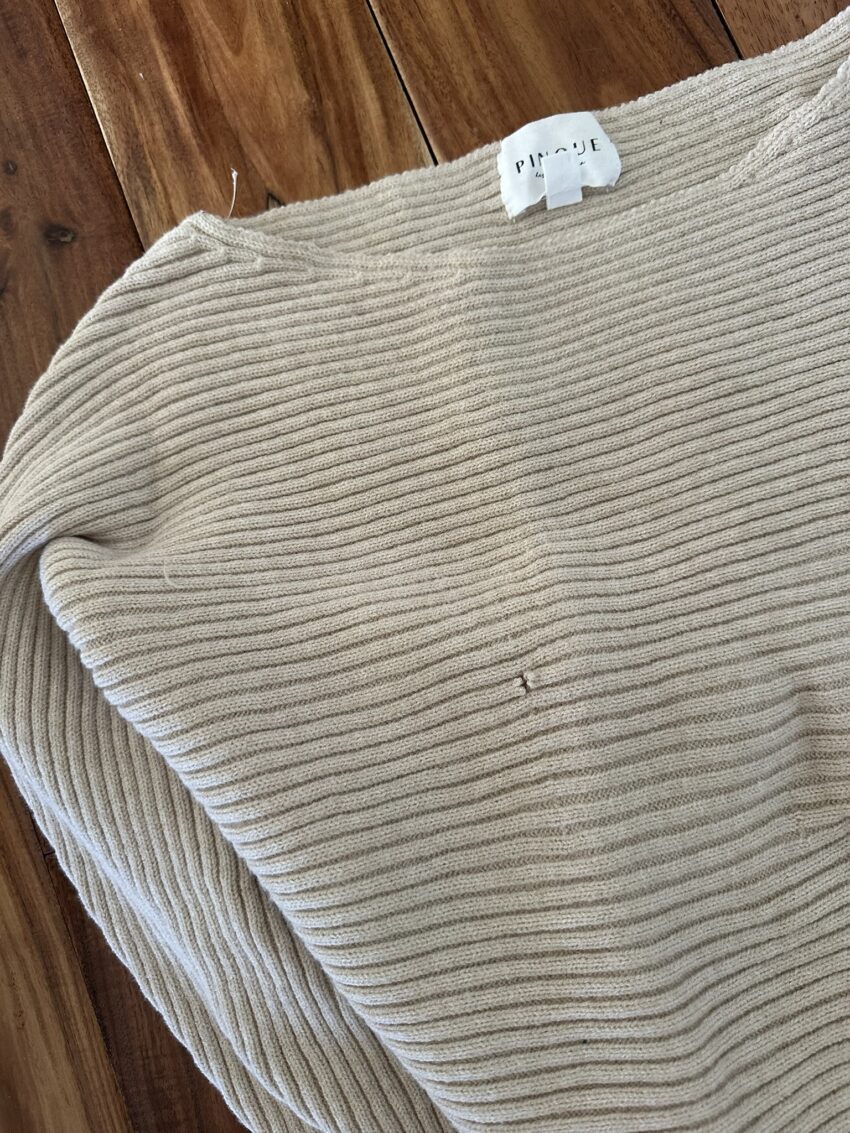
I have a sweater sitting in my closet. I love this sweater a lot. In fact, when I put it on for the first time, it felt amazing, I felt amazing, life was good.
After about my second time wearing this sweater, my cat ripped a hole in it.
Now, I either have to throw the sweater away, keep it but only wear it at home, demoting it to something less than the beautiful status it once deserved, or figure out a way to repair it.
Which brings me to your question. When somebody gets angry with you, it’s a lot like your cat ripping a hole in your sweater, isn’t it? Except when somebody gets angry with you, it’s actually the relationship that has been damaged, the relationship has a hole in it. And now you have to decide what you will do.
Feeling embarrassed is a perfectly typical reaction when somebody gets angry with you. Maybe you feel embarrassed because you recognize that they are mad at you because you did something you shouldn’t have done, as is often the case for me. Or maybe they got mad at you as the result of you breaking some sort of unspoken agreement that you didn’t even know existed and you’re embarrassed about that. Maybe you actually didn’t do anything wrong at all, but they misunderstood something or assumed the worst of you and jumped to conclusions, leaving you feeling misunderstood and out of sorts.
Regardless, the truth is that someone is mad at you and that might feel like you’re the “bad” one, at least in their eyes. And being the bad one triggers a shame response. Fair enough.
Most of us, in fact, were called “bad” at one point or another in our childhoods. Kids are called bad all the time, which I think is an overused term and honestly quite terrible. After all, why should adults just get to label kids bad all of the time when we don’t want anyone labeling us bad? I digress.
Sure, you can say that childhood should have nothing to do with it. Yes, you’re probably right. But let’s face it, a lot of our today crap has to do with our yesterday crap, as annoying as that is. Of course, I’m not meaning to imply that it’s acceptable to blame anything on our childhood. Blame is not what I’m looking for here, but rather explanation, understanding and therefore freedom to choose something different. It is very likely that whomever called us “bad” in childhood did not mean to permanently instill in us this thought, this fear. Some of us, though, are more sensitively tuned than others to internalize these sorts of things. Maybe you’re one of these people. I know I am.
Either way, fast forward to today and somebody getting mad at you – it might trigger all of those feelings of not being good enough. It might launch you into a whole shame spiral where you feel like they are casting some supreme judgment on you. This inevitably kicks you into some sort of reaction (think fight, flight, freeze, fawn, etc.) and then you’ll be off and running, no pun intended.
We can call this whole thing a rupture. This is the hole in the fabric of the relationship – something has happened, someone has gotten angry – there is a discontinuity.
But this is where you have a choice. This is where there is a fork in the road. From here, things can get better or they can get worse. And the improvement or the deterioration can be fast or it can happen slowly over time.
I can honestly say that I WISH that somebody would have told me how to repair these little ruptures, or just as importantly, how to recognize when these ruptures are unrepairable.
If you have a hole in a sweater that you once loved, you might not love it as much anymore or, even if you do, you will likely want to avoid looking at it. Now it just causes you pain. If you do bring it out without repairing it, things are more likely to snag it, making the hole bigger. Or it might start to fray right in that spot. Either way, the sweater is now compromised. It’s just not the same as before.
Our relationships are no different. You can try to ignore ruptures. You can try to pretend they aren’t there. But that will not fix them. Now you have a relationship that you find yourself avoiding or you find yourself with a relationship that is more likely to fray.
But repairing a rupture can be difficult, so maybe your instinct is to avoid it at all costs. Especially because, in the case of a relationship, repair depends very heavily on input from both sides of the relationship, both involved parties. (Thank GOD we don’t have to get consent from our sweaters in order to mend them!) If the other person wants to repair, but you don’t, then it’s unlikely to happen. Likewise if you want to repair but the other person doesn’t, it’s also unlikely to happen.
But if you’re both interested in repairing, the question then is what does that repair look like? How do you do it?
If your natural instinct is to flee (be that through physical hiding, emotional hiding, withdrawing from the relationship or what have you), then you are leaving behind all of the potential repair. This is like throwing the sweater in a corner of your closet and just ignoring it for a bit. Eventually you might get it back out again, but then maybe it’s grown musty and dirty from laying on the floor for so long. Or maybe you are determined to avoid looking at that hole, and you don’t know how to fix the hole, so you just avoid the sweater forever.
Alternatively, if you tend toward a fight response (think getting angry at the person who is angry with you), then you are also destroying the chance at being able to repair the relationship. In this case, you’re taking the small hole and purposefully making it larger, more difficult to repair.
Or maybe you do something else altogether, but it definitely isn’t repair.
Regardless, let me give you another option.
My suggestion is to look at the situation as honestly as you can (without judgment, without name-calling (of self or others), without exaggeration of facts), and decide if you feel good about your actions. If you don’t, decide what action you yourself can take to rectify things. You get to decide the action here. If you need to apologize then do it, if you need to seek clarity, then do that.
Then, in whatever way feels right to you, decide if you want to repair the hole (regardless of who’s fault you believe it was). If you do, find out (you get to choose how best to do this!) if the other person also wants to repair the hole. If they do, then be honest with yourself and them about what you need for the repair (and if you don’t know what you need, then say that), and then see what they say. Likewise, ask them what they need for repair and listen to their answer. Once the requirements are laid out, see if you are each willing to offer what the other is needing. And, if not, are you willing to negotiate?This might go back and forth quite a few times until you figure things out. You will know when you have figured things out.
I know this sounds like a lot of work, and it can be, but it usually isn’t so intense. It sounds more intense than it is.
Let’s take a look at a few examples of what this might look like in the real world.
Small Breach
Let’s say that you are supposed to meet your friend Katy for coffee and you oversleep and are running 30 minutes late. You text her right at the time you are supposed to meet and tell her that you’re late. When you get to the coffee shop, Katy is visibly annoyed. Your options are:
A. When you realize she’s annoyed, you get annoyed that she’s annoyed and your coffee date is stilted and awkward and silent.
B. When you realize she’s annoyed, you get angry, telling her maybe you shouldn’t meet for coffee anymore if she’s going to be so sensitive.
C. When you realize she’s annoyed, you understand that you were the one that overslept, so you apologize and ask her if she will forgive you. She says yes. You ask her if she needs anything more than that, to which she replies that she would like you to text her next time when you know you’re going to be late rather than waiting. You agree. You hug and just like that, the rupture is repaired.
I think it’s obvious that Option C wins out by a landslide! Option C is the only option that will maintain the integrity of the relationship.
Medium Breach
Now let’s take a slightly bigger example:
Let’s say that you’re eating lunch with a couple of friends, Jane and Carly. Jane had sent you a video that she wished to keep private from Carly for unspecified reasons, but you don’t realize this and you bring it up. Jane immediately responds with something that lets you know that she doesn’t want Carly to know about the video. Because you don’t fully understand her non-verbal (and verbal) cues, you go on to reveal the secret to Carly. Jane is now angry with you. What are your options?
A. You yell at Jane that she is being unreasonable and leave the table immediately, storming out of the restaurant.
B. You change the subject and ignore Jane’s seething anger, choosing to pretend that everything is fine.
C. You go quiet, fighting back tears, and avoid direct interaction with Jane for the rest of lunch. Focusing on Carly you say, “This is why I don’t have lunch with Jane more often.” As soon as it’s time to pay, you quickly pay and then leave the restaurant without saying goodbye.
D. You turn to Jane and simply say, “I’m sorry, Jane. I messed up. Do you forgive me?”
The first three responses are combinations and permutations of fight, flight, avoidance (changing the subject, running physically away), and defensiveness (retaliatory anger, making snide remarks). The fourth option is the one that lends itself to the potential of repairing the rupture in the healthiest way. Even though Jane might still be mad and might need more time (and even conversation) before she is willing to move on, or perhaps before she is willing to trust you with something again, this is the shortest, most direct, path to regaining trust between the two of you.
This breach is a little bigger but all you can do is state your intention to repair and see what will be required to do that. Then listen and respond, listen and respond, keeping the repair goal in mind, until you both feel satisfied that the hole has been mended.
Note: If you believe that making a mistake (or admitting that you’ve made a mistake) means that you’re bad person, then you might be willing to do anything at all to avoid being perceived as messing up.
Let’s look at the example above. Maybe this is actually what’s happening here in the first three options. Maybe your self-esteem is so threatened that you cannot bear to even admit to yourself that what you did might have been wrong, even if it was an innocent error, a misreading of a situation. Maybe you’re tired of misreading social cues. Maybe this has happened more than you care to admit, to the point that you feel like people are always mad at you.
Instead of stopping and facing the pain that you, however inadvertently, created, you try to dodge it. But the hole exists whether or not you are looking at it. And the longer you avoid it, the worse it has the potential to become. So I urge you to not fear admitting mistakes, especially when a relationship is on the line.
Big Breach
Now let’s take an example of something that is large enough to destroy a relationship.
Let’s say that you are in a relationship and you have started having a lot of contact with a single friend of yours. It’s largely very innocent, but there might be some innocent (or not-so-innocent?) flirting going on. You know you would never physically cheat, though. Your partner ends up finding text messages between the two of you that upset him, and he expresses anger about how you’re interacting with this friend.
A. When faced with his anger, you yell back at him, telling him that you don’t like everything he does either.
B. When faced with his anger, you withdraw in silence for however long it takes for him to forget about his anger.
C. When faced with his anger, you escalate your interactions with this friend, growing more flirtatious and inappropriate just to show him that you won’t be controlled.
D. When faced with his anger, you hear him out. If you recognize what might have upset him, you apologize – simply, but sincerely. If you determine that you both want to repair the rupture, you move into the stage where you define what’s required for the repair and negotiate your way toward that, perhaps coming up with some new explicit agreements on how to move forward together.
Option D is the clear winner – any of the other options will certainly keep the breach unrepaired. While it might feel uncomfortable, heading directly into the discomfort is the way to begin a repair.
It’s important to remember that both sides must be both able and willing, to directly face that the breach happened, including discussing the facts of the breach and any steps toward potential repair.
What might happen when one or both of the parties involved is closed off to the repair? If either person is uninterested in repairing the relationship, they block growth and sometimes the relationship is lost. If the person you have the breach takes that stance, whether you agree with it or not, there is not much you can do. This is commonly called a grudge. And if someone is steeped in grudge-holding energy, then there might not be much that can be done to salvage the relationship.
On the other hand, sometimes the rupture will be swiftly swept under the rug, ignored by both parties, before it can be repaired. Think of it as putting a very temporary patch (a small piece of duct tape, perhaps) over the hole in the sweater, which stops the immediate unraveling. However, the hole is still there and the tape will likely fall off at some point, leaving the hole exposed again. Temporary patches in relationships aren’t true repair, but are rather a bit more like a glossing over. We commonly call this avoidance. Avoided things, though, still exist and usually they can only be avoided for so long. When something comes up again to remind either party of the ignored issue, the original rupture is likely to occur all over again.
If, though, you can successfully navigate the repair, the good news is that the repair often ends up strengthening the relationship. Because you both have now demonstrated your intention to continue the relationship, even when breaches happen, you have paved the way toward easier future repairs. Additional trust has been built and the relationship is stronger than ever.
Please rest assured that it takes an incredible amount of strength to do what I am suggesting. You might fear that you will appear weak by not fighting, by not leaving, by not somehow protecting yourself. Facing the repair isn’t weakness, it’s strength. It might feel uncomfortable at first, almost like you are allowing yourself to be mistreated or otherwise taken advantage of, but see it through. Remind yourself that you are showing up stronger than ever by seeking to repair.
So back to your question. You said that when people get upset with you, you tend to run away or lash out which makes things worse. I’ve now given you other options that you can use when you’re facing somebody’s anger. So the next time you find yourself in a situation like this, try to pause for a moment and consider your alternatives. Then head toward repair, if repair is what you want.
And if you do end up reverting back into your typical ways and reacting in the moment, go easy on yourself. It is never too late to turn around or make a phone call and say, “Hey, that’s not what I meant to do. Actually…” and then start over.
Learn the art of repairing ruptures early and use it often. Your relationships will be stronger and your life richer.
Now, I have a sweater that I need to go repair.